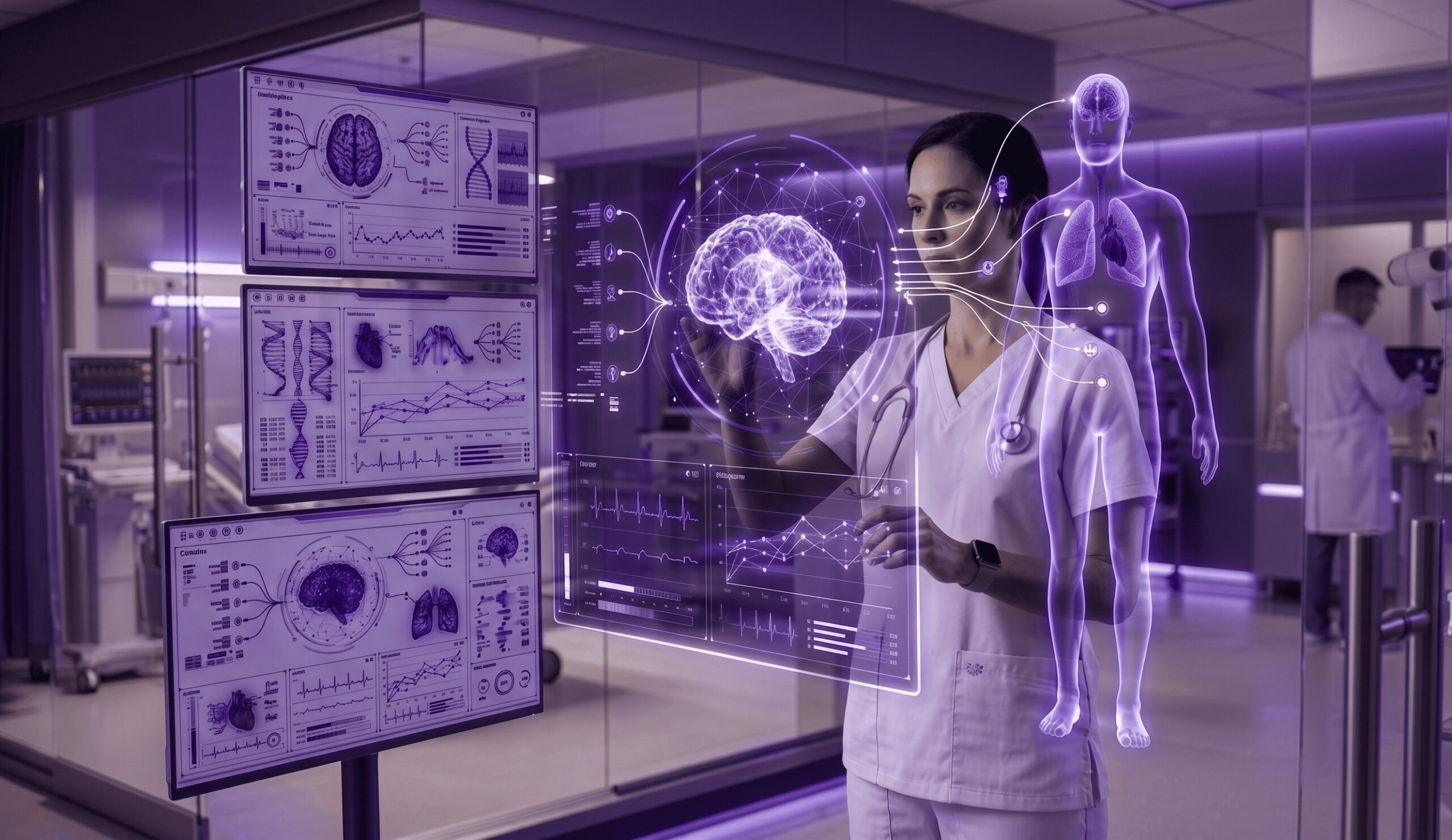


I want to talk to you about something that I think is really important. Nobody in the AI space wants to admit this. Healthcare got sold a dream that took way too long to show up. For over a decade hospitals kept buying AI software health systems kept signing massive contracts and most of those tools? They ended up not being used. They were overpromised.
I want to be honest with you. Something has actually changed in the couple of years. Not in a “this time its different” kind of way. In a measurable you-can-see-it-in-clinical-outcomes kind of way.
So this is not going to be another one of those “AI will save healthcare” articles. I have read enough of those. So have you. This is about what’s actually working right now when it comes to machine learning, NLP and predictive analytics in patient care. What is still falling short..
Where things are headed. If you are a healthcare executive, a CTO at a health tech startup or someone exploring AI healthcare applications for your organization I wrote this for you.
Lets get into it.
Why Healthcare Needed AI in the First Place
Let me paint a picture for you. The average physician in the US spends two hours on administrative work for every one hour of direct patient care. Two to one. I want you to think about that for a second. Documentation, medical coding, prior authorizations, inbox management. Clinicians are drowning in paperwork. Its been this way for years.
Now layer on top of that the volume of medical knowledge that exists today. It doubles every 73 days. No human being can keep up with that. It’s just not possible. A radiologist is reading hundreds of imaging scans per day. A pathologist is making judgment calls on tissue samples under time pressure. An ER physician is triaging patients while juggling a dozen active cases simultaneously.
This is why artificial intelligence in medicine is not some to-have anymore. Its becoming a necessity.. I want to be careful with that word because people throw it around too loosely.. When you look at the math when you see the burnout numbers when you talk to actual clinicians about their daily workload you understand why.
Not to replace doctors. Let me be clear about that because that conversation is tired and mostly wrong. The point is to handle the parts of medicine that machinesre objectively better at. Pattern recognition across datasets. Real-time monitoring at scale. Processing data that no human could get through fast enough no matter how hard they tried.
The question was never whether AI would show up in healthcare. It was always whether it would show up in a way that actually helps people than just adding another layer of technology to manage.
Machine Learning in Healthcare: Where It Is Actually Making a Difference
People love talking about the stuff when it comes to machine learning in healthcare. Robot surgeons. AI that outperforms oncologists. Those headlines get clicks.. They skip over the work that is quietly having the biggest impact right now.. That bothers me because the quiet stuff is where the real value is.
Medical Imaging and AI-Powered Diagnostics
This is probably the most mature use case. Powered diagnostics in radiology and pathology have moved well past the research phase. This is real. It’s in workflows right now. Machine learning models trained on millions of images can flag potential abnormalities in X-rays CT scans, MRIs and mammograms with accuracy that is genuinely impressive.
I need to say something here because it always comes up. These tools are not replacing radiologists. Every time AI in healthcare gets discussed someone jumps to “robotsre taking our jobs” and its exhausting. What these models are doing is acting as a set of eyes. The radiologist reads the scan, the AI highlights areas of concern and the clinician makes the call. That’s it.. In practice that means fewer things get missed. In high-volume settings where fatigue is a real factor and people are reading scan after scan after scan for hours.
AI in medical imaging is also doing something really practical with triage. When an AI model can flag findings in real time and push urgent cases to the front of the queue the patient having a stroke isn’t sitting behind 40 routine follow-ups. That kind of prioritization saves lives. Not theoretically. Actually.
Clinical Decision Support
Now here is where things get interesting for day-to-day care if you ask me. Clinical decision support systems powered by AI can look at a patients medical history their lab results, current medications, vitals, all of it and surface things that a busy physician might not have the bandwidth to piece together on their own.
Think about it like this. A patient walks into the ER with chest pain. The physician is mentally running through diagnoses while also managing four other patients who all need attention right now. A clinical decision support tool can pull in that patients history compare it against patterns from millions of cases and flag the risk factors that might change the approach.
I want to be really clear about something. The AI is not making decisions for doctors. That’s a distinction. What it is doing is making sure the right information is visible to the person at the right moment. In a field where one missed detail can be the difference between catching something and missing it entirely that is enormous.
Drug Discovery and Clinical Trials
Here is an area that doesn’t get attention outside of pharma circles. Traditional drug discovery takes 10 to 15 years. Costs billions. Billions. Machine learning is compressing that timeline by identifying promising drug candidates predicting molecular interactions with biological targets and helping design smarter clinical trials.
AI drug discovery isn’t replacing the method. What its doing is turbocharging the hypothesis phase. Of brute-forcing through thousands of compounds one by one machine learning models narrow the field to the most promising candidates in a fraction of the time. Some pharmaceutical companies are already seeing AI-assisted pipelines cut early-stage discovery timelines significantly.. When you are talking about diseases that people are dying from right now that time compression matters more than most people realize.
Clinical trials are getting smarter too. AI can identify patient populations for a study predict enrollment challenges before they derail a timeline and monitor trial data in real time to catch safety signals earlier. This is especially valuable for diseases where finding enough eligible patients has always been one of the hardest parts.
Actually here is something worth paying attention to. The intersection of AI drug discovery and personalized medicine is where things start getting really powerful. Machine learning models can now analyze a patients profile and predict which compounds are most likely to work for their specific disease variant. This is already happening in oncology. Tumor genomics matched against drug response databases to identify therapies. Still early.. The direction is unmistakable and the pace is picking up.
Predictive Maintenance for Medical Equipment
This one flies completely under the radar. I think it matters more than people give it credit for. Hospitals run on equipment. MRI machines. Ventilators. Infusion pumps. Surgical robots.
When something critical goes down unexpectedly it doesn’t just cost money. It disrupts care. Procedures get delayed. People wait longer than they should.
Machine learning models trained on equipment performance data can predict failures before they happen. The model learns what normal looks like for a machine and flags when something starts drifting from that baseline. Maintenance teams can then step in proactively of scrambling after a breakdown during a procedure. It’s basically the idea as predictive analytics for patient deterioration but applied to the machines instead of the people.
NLP in Healthcare: Turning Unstructured Data Into Usable Intelligence
If machine learning is the engine natural language processing is the translator.. Healthcare desperately needs a translator because heres the thing most people, outside of health IT don’t realize. The vast Natural language processing models that are trained on terms can find diagnoses, medications, procedures and other important information from notes that are written in a free style and organize that information so it can be analyzed. This is a deal. I do not think people understand how big this is. It means a health system can ask questions like how many of their patients who have diabetesre also showing early signs of kidney disease. Which patients who are taking this medication are talking about side effects when they visit their doctor. Those questions were almost impossible to answer before natural language processing models existed. Now they take a few seconds.
Ambient Clinical Documentation
This is the natural language processing application that doctors who are actually practicing medicine seem to care about the right now.. I understand why. Ambient clinical documentation uses intelligence to listen to the conversation between the doctor and the patient and automatically write the clinical note in real time. The doctor focuses on the patient and talks to them like a being. The artificial intelligence writes the note. The doctor reviews it. Edits what needs to be edited and signs off.
I will tell you something. This is one of the artificial intelligence applications where I have seen real excitement from doctors who are working on the front lines. Not just polite interest. Not yeah that could be useful.” Real excitement. Because it directly addresses the problem of burnout. Of spending thirty to forty-five minutes after every patient visit typing notes on a keyboard the conversation ends and the note is already mostly done.
It is not perfect. Let us be realistic about that. The notes still need to be reviewed by a human. Some specialties have complex documentation requirements than others.. Even in its current state it is saving doctors a lot of time every single day.. In a profession where burnout is causing people to leave clinical practice entirely that matters more than most technology improvements do.
Coding and Revenue Cycle
Natural language processing is also making an impact on the revenue cycle. Medical coding, which is the process of translating documentation into billing codes has traditionally been done by hand slowly and with a lot of errors. Natural language processing tools can now read notes and suggest the right codes while flagging discrepancies and reducing the back-and-forth between clinicians and coding teams.
I know this does not sound as exciting as intelligence diagnosing diseases.. Talk to any hospital chief financial officer and this is one of the applications of artificial intelligence in medicine that they will point to as having the highest return on investment. Faster coding means reimbursement. Fewer errors mean denied claims.. In an industry where margins are very thin every percentage point matters.
There is another natural language processing application in this area that is gaining momentum. Prior authorization automation. If you have ever dealt with the authorization process in healthcare you know exactly how painful it is. Faxes, phone calls, hours of back-and-forth between payers and providers. Natural language processing tools can now read what the payer requires compare it to the patients documentation and either generate the authorization request automatically or flag exactly what additional information is needed. For health systems that process thousands of authorizations per month this alone can recover significant revenue and save administrative staff from a lot of work.
Predictive Analytics in Healthcare: Getting Ahead of Problems Before They Happen
This is the area that I personally find the compelling. Predictive analytics in healthcare is about using data to see what is coming before it arrives and stepping in enough to change the outcome. That is it. Everything else is details.
Predicting Patient Deterioration
Hospital readmissions and unexpected patient deterioration are two of the expensive and most preventable problems in healthcare. Predictive analytics models can analyze time patient data, including vital signs, lab trends, nursing assessments and medication responses to generate early warning scores that flag who is at risk of declining.
This is not just theoretical. It is being used in care units and general medical floors across the country right now. When a model picks up that a patients numbers are trending toward sepsis or failure it triggers an alert to the care team. Sometimes hours before monitoring methods would catch the same thing. That early warning window is often the difference between a straightforward intervention and a code blue.
Population Health Management
If you zoom out from patients predictive analytics starts doing something really valuable at the health system level. Population health management powered by intelligence means organizations can now identify which patients in their network are most likely to develop chronic conditions, who is at highest risk for an emergency visit and who would benefit most from a proactive phone call or outreach.
Healthcare data analytics at this scale requires pulling clinical data, social determinants claims information and sometimes even geospatial data. It is complex.. When it is done well it lets health systems put resources where they will actually make a difference instead of spreading everything thin and hoping for the best.
Remote Patient Monitoring and Chronic Disease Management
Remote patient monitoring intelligence is where predictive analytics meets the real world of connected devices. Patients who are managing conditions like diabetes, heart failure or chronic obstructive pulmonary disease are getting equipped with wearable sensors and home monitoring devices that stream data continuously back to their care team.
Here is the thing though. Data without intelligence is noise. A nurse cannot physically watch feeds from five hundred patients at the same time. Nobody can.. A predictive model can. It monitors all of them learns each patients baseline and only alerts the care team when something genuinely deviates from what is expected. That keeps people out of the hospital by catching problems before they become emergencies.
I have talked to care managers who told me they went from spending their day staring at dashboards and manually reviewing patient data to actually picking up the phone and talking to patients. Coordinating care. Building relationships. That is what artificial intelligence should be doing. Not replacing the part. Getting rid of the data processing part so the human part can actually happen. That is what good AI for patient care actually looks like in practice.
Mental Health and Behavioral Analytics
I want to highlight an emerging area because I think it deserves way more attention than it is getting. Predictive analytics is starting to be applied to health. Models can look at patterns in behavior like changes in appointment attendance, medication refill timing, language shifts in patient portal messages and flag individuals who might be heading toward a crisis.
I want to be thoughtful about how I talk about this because it’s sensitive. You cannot just throw algorithms at health and call it progress. It has to be done with care with oversight and with an understanding of the ethical stakes.. The potential here is real. Especially in a country facing a shortage of mental health providers. Artificial intelligence is not going to replace a therapist. It should not try to.. It can help make sure the patients who need urgent attention get identified and connected to support before things spiral.
The Challenges Nobody Wants to Talk About
I would be doing you a disservice if I only covered what is working. The reality is that artificial intelligence in healthcare still has problems and glossing over them does not help anyone make better decisions. So let us talk about the parts.
Data Quality and Interoperability
Here is the elephant in every room where healthcare artificial intelligence gets discussed. Machine learning models are only as good as the data they learn from.. Healthcare data is messy. Like really messy. Different hospitals run electronic health record systems. Different doctors document differently. Lab results come in formats. Imaging data lives in standards.
Building intelligence healthcare applications that work reliably across multiple health systems takes an enormous amount of data cleaning, normalization and integration work.. Most organizations completely underestimate this part. They get excited about the model. They want to talk about algorithms and accuracy metrics. Eighty percent of the actual work is wrangling the data into a state where the model can learn anything useful from it at all.
HIPAA Compliance and Data Privacy
Non-negotiable. Full stop. Any artificial intelligence system that touches data has to be HIPAA compliant. Encryption at rest and in transit. Strict access controls. Audit logging. Business associate agreements with every vendor. A clear framework for what data gets used for training versus inference.
I have personally seen projects stall for months because nobody thought about the compliance architecture until the model was already built. If you are building or buying healthcare intelligence solutions the privacy and security conversation needs to happen on day one. Not week six. Not, after the demo. Day one.
Bias and Equity
This one is important. It does not get talked about enough in practical terms. Machine learning models trained on data produce biased outputs. In healthcare that is I want to be careful when talking about the future of Artificial Intelligence because predictions about Artificial Intelligence do not always turn out to be correct.. There are a few things that seem pretty clear right now.
Multimodal Artificial Intelligence
The next big thing in Artificial Intelligence in medicine is going to be combining types of data all at once. Now most systems only work with one type of data at a time. One model for images another for lab results and another for doctors notes. Multimodal Artificial Intelligence brings all of these things together. Imagine a system that can look at a patients scan their lab results, their list of medications and their doctors notes all at the same time and give a clear picture of what is going on. That is where Artificial Intelligence in medicine is headed.. To be honest it cannot happen soon enough. If you hear people talking about multimodal AI this is exactly what they mean.
Artificial Intelligence Powered Personalized Treatment Plans
As we get better at analyzing healthcare data we are getting closer to being able to give patients personalized treatment plans. Not the kind of plan where everyone with a condition gets the same treatment.. The kind of plan that takes into account a patients specific genetic profile, their other health conditions, their lifestyle and how other patients like them have responded to different treatments. This is already happening in cancer treatment.. It is starting to happen in other areas of medicine too. This is going to change the way we make decisions about treatment.
Operational Artificial Intelligence
Artificial Intelligence is also being used to help with the business side of running a healthcare system. This includes predicting how many patients will be coming in making sure we have the staff on duty managing our supplies reducing wait times and making it easier to schedule appointments. These things may not make headlines. They have a big impact on whether patients have a good experience or a frustrating one.. They also affect whether the healthcare system can stay financially stable while providing good care.
What This Means If You Are Building Healthcare Artificial Intelligence
If you are a healthcare technology company, a hospital system or a startup working on Artificial Intelligence healthcare applications here is what I want to tell you. This is based on what we have learned from working on hundreds of Artificial Intelligence projects.
Start by identifying a problem that needs to be solved. Do not start with the technology. Every organization that has been successful with Artificial Intelligence in healthcare started by identifying a problem and then figured out which Artificial Intelligence approach would solve it. The ones that failed were the ones that started by saying “we need an Artificial Intelligence strategy” and then spent months looking for a problem to solve.
Invest in your data infrastructure. This is the part that nobody wants to spend money on.. If your data is not clean, standardized and easy to access nothing else matters. The hard work of making sure your data is good is the foundation that everything else is built on.
Build your system to comply with regulations from the start. Artificial Intelligence that complies with HIPAA is not something you can add later. It is a decision that affects every part of your system. Treat it that way.
Design your system for the people who will be using it not for the people, in the boardroom. A tool that looks great in a presentation but makes it harder for doctors to do their jobs will not be used. Spend time with the people who will be using your system. Watch how they work. Build something that fits their needs.
If you need help building any of this that is what we do. Resourcifi Artificial Intelligence works with healthcare organizations and healthcare technology companies to design, build and deploy Artificial Intelligence systems that actually work in healthcare settings. We can help with machine learning models, natural language processing pipelines, predictive analytics platforms and more. We have the engineering talent and the understanding of the healthcare industry to take these projects from idea to reality.
Are you wondering if Artificial Intelligence could help solve a problem in your organization? Let us talk about it.