

AI in logistics is changing how companies manage their supply chains, plan routes and run warehouse operations. For years the logistics industry has been talking about AI. The results have been underwhelming. Most of the time it has been limited to pilot programs and proof of concepts that never made it to production.
Something has genuinely shifted. Companies that got their data infrastructure right are now seeing measurable results from AI in logistics. Not theoretical results. Real results in warehouses on actual delivery routes and across actual supply chains that move real products to real customers.
This is not going to be another article about how AI in logistics will transform logistics. I have read enough of those. So have you. This is about what machine learning in logistics is doing right now. What is working? What is still hard? What you need to know if you are running a logistics operation or building technology for one.
Why Logistics Was Always Going to Be an AI in Logistics Problem
The logistics industry was always going to need artificial intelligence in supply chain management. A single large retailer might have thousands of products moving through dozens of distribution centers across countries. Each product has its demand patterns, shelf life, storage requirements and shipping constraints.
Multiply all of that together. You are looking at a decision space that no human planner can optimize manually. It is many variables interacting in too many ways.
Then add the volatility. Consumer demand shifts constantly. Weather disrupts transportation networks with zero warning. Suppliers miss delivery windows. Ports get congested. Labor shortages hit out of nowhere.
This is why AI in logistics is not a luxury anymore. It is becoming the baseline for companies that want to stay competitive. Machine learning handles the complexity adapts to the volatility and operates at the speed that modern logistics demands.
AI Supply Chain: From Reactive to Predictive
The shift from reactive to operations is the most impactful application of AI in logistics in the supply chain space. For decades supply chain management has been fundamentally reactive. Something goes wrong. Then you scramble to fix it.
AI in logistics supply chain technology is flipping that model completely. Predictive analytics in logistics is at the heart of that shift.
Demand Forecasting AI in Logistics
Demand forecasting AI in logistics is probably the mature and most valuable application of machine learning in logistics right now. Traditional demand forecasting relies on sales data. Maybe some seasonal adjustments.
Machine learning models for demand forecasting can incorporate hundreds of variables simultaneously. Historical sales data, yes. Also weather patterns, social media trends, economic indicators, competitor pricing, promotional calendars, local events and even news sentiment.
AI in Logistics Inventory Management
Closely tied to demand forecasting is AI in logistics inventory management. Once you know what demand is going to look like the question is how inventory to hold, where to hold it and when to reorder.
Machine learning models can dynamically adjust inventory levels based on real-time demand signals, supplier lead time variability, transportation disruptions. Even predicted future events. AI inventory management like this was not possible with traditional methods.
Supply Chain Optimization AI in Logistics
At a level supply chain optimization AI in logistics is being used to make strategic decisions about network design, sourcing strategy and distribution planning.
AI in Logistics Route Planning: Getting Things Faster and Cheaper
AI in logistics route planning is changing how companies move goods and honestly the cost savings are significant. AI shipping optimization is a big part of that because it helps companies pick the right carrier for each shipment in real time. AI freight management models make that matching happen automatically based on cost, speed and reliability.
Dynamic Route Optimization
Traditional route planning tools generate routes based on distance and maybe traffic patterns. Machine learning models for route optimization can process all of these constraints simultaneously. AI route planning is where a lot of the immediate cost savings in logistics come from. AI fleet management takes this further by optimizing vehicle assignment and driver allocation across the entire fleet.
AI in Logistics Last Mile Delivery
AI in logistics last mile delivery is the problem in the delivery chain and typically the most expensive. Machine learning models trained on delivery data can predict delivery success rates by address, optimal delivery windows by neighborhood parking availability by time of day and even which access instructions are most likely to be correct. AI last mile delivery is where all of this intelligence comes together to reduce failed attempts and cut costs.
AI Warehouse Operations: Smarter Not Faster
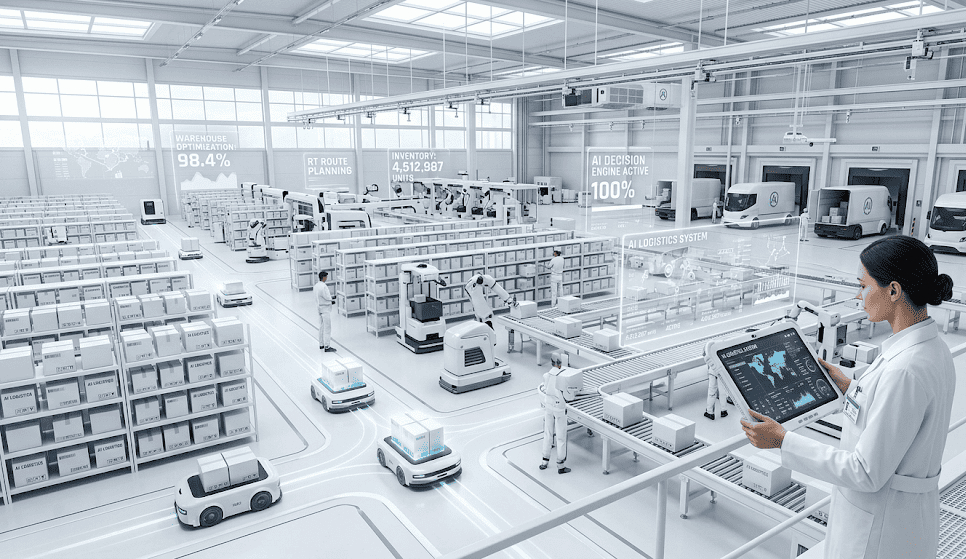
Warehouses are where AI in logistics really gets to work. AI technology for warehouse operations is being used in every part of managing a warehouse from getting goods to putting them to picking and packing and shipping. Real-time tracking AI extends this visibility across the entire network so you know where every shipment is at all times.
Computer Vision in Warehouses
Computer vision in warehouses is one of the uses of AI I have seen. Cameras and sensors that use machine learning can check what is in a shipment when it arrives find damaged goods before they are stored watch how goods are stored and help with picking.
Robotic Process Automation Logistics
Robotic process automation in logistics includes both robots and software automation in warehouses. Physical robots are doing tasks like moving pallets on their own bringing goods to people and sorting.
NLP in Logistics: The Application Nobody Talks About
NLP in logistics is quietly automating some of the work in the industry. Logistics is about documents. There are bills of lading, customs forms, proof of delivery, freight invoices and more.
The Challenges That Slow Logistics AI Down
AI in logistics has challenges. You need to understand them before you invest.
Data Quality
Data quality is the challenge. Logistics data is messy. It comes from systems that were not designed to work together.
Integration Complexity
Logistics operations use technology with a lot of systems. Integrating AI solutions with existing systems is technically hard. Logistics automation AI solutions that require replacing everything are non-starters for most organizations.
Change Management
Logistics is an industry with a lot of operators who have been doing things a certain way for a long time. They are often right to be skeptical.
ROI Measurement
Measuring the benefit of logistics AI can be hard because the benefits show up in areas and over time.
Where Logistics AI Is Headed
There are a few directions that seem clear.
AI in transportation is moving toward operations. Autonomous logistics AI is driving that shift. Digital twins powered by AI are becoming more common in logistics.
Sustainability optimization is becoming a real use case. Machine learning models that optimize for carbon emissions alongside cost and service levels.
What This Means If You Are Building Logistics AI
If you are a logistics company a supply chain technology provider or a startup building AI-powered logistics products here is what I would tell you.
Start with your data. Before you build any models make sure your data is solid. Clean consistent accessible data is the prerequisite for everything.
Pick one problem. Solve it well. Do not try to build an end-to-end AI logistics platform at once.
Build for integration, not replacement. Your AI solution needs to work with existing systems.
Invest in change management. The technology is the part. Getting people to trust and use the technology is the part.
If you need help building any of this that is what we do. We work with logistics companies and supply chain technology providers to design, build and deploy AI systems that handle the complexity of logistics operations.
Curious whether AI could solve a problem, in your logistics operation? Let us talk about it.